

Part 1: Desktop application
Cleaning your first document (desktop)
Open Draftable Clean to see the main application window with the toolbar across the top.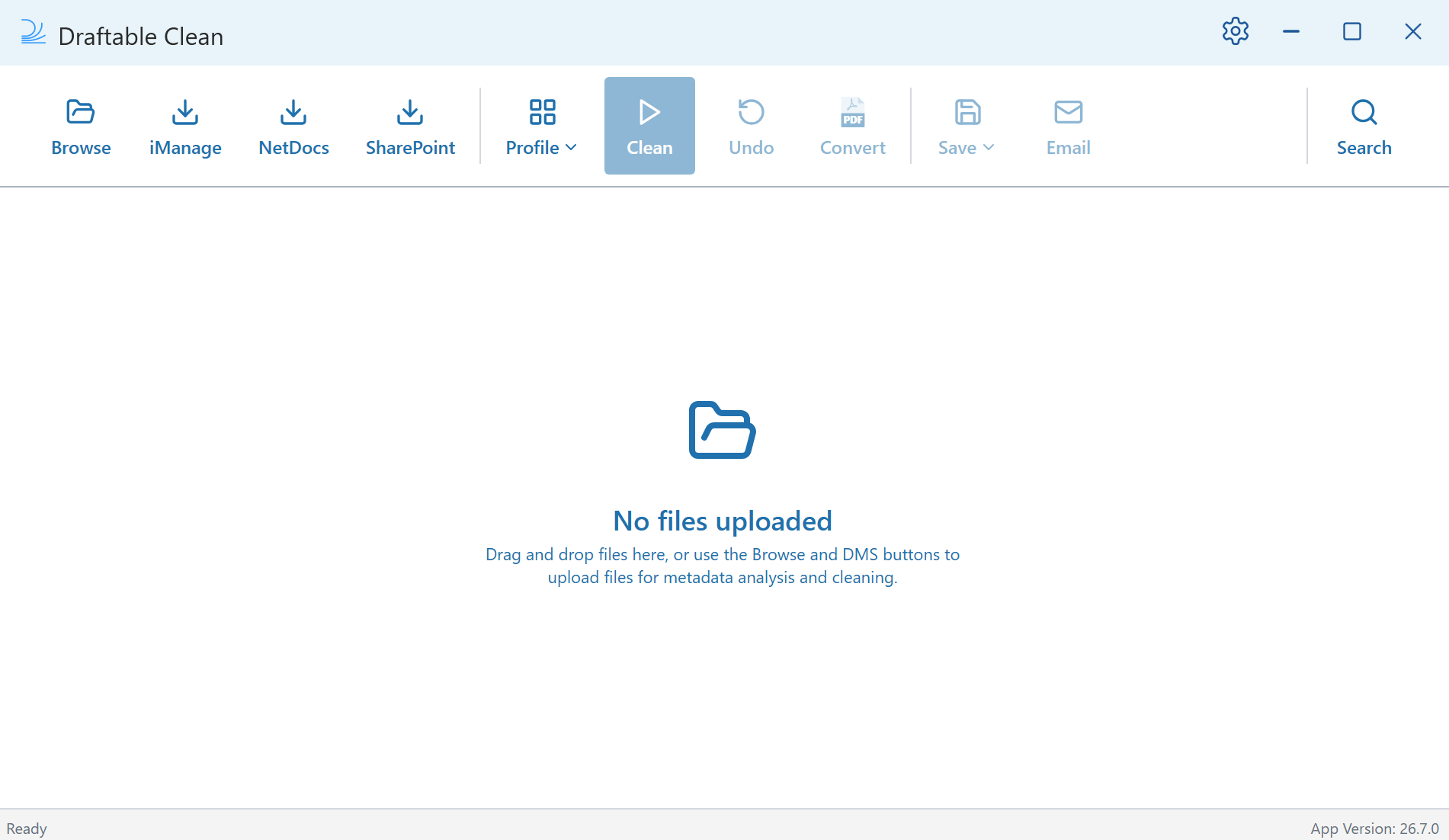
- Upload — Browse, iManage, NetDocs, SharePoint
- Clean — Clean, Undo
- Export — Save, Email
1
UPLOAD: Add files to Draftable Clean by clicking Browse to select documents from a local folder, iManage, NetDocs, or SharePoint to upload from your document management system, or by dragging and dropping files directly into the application window.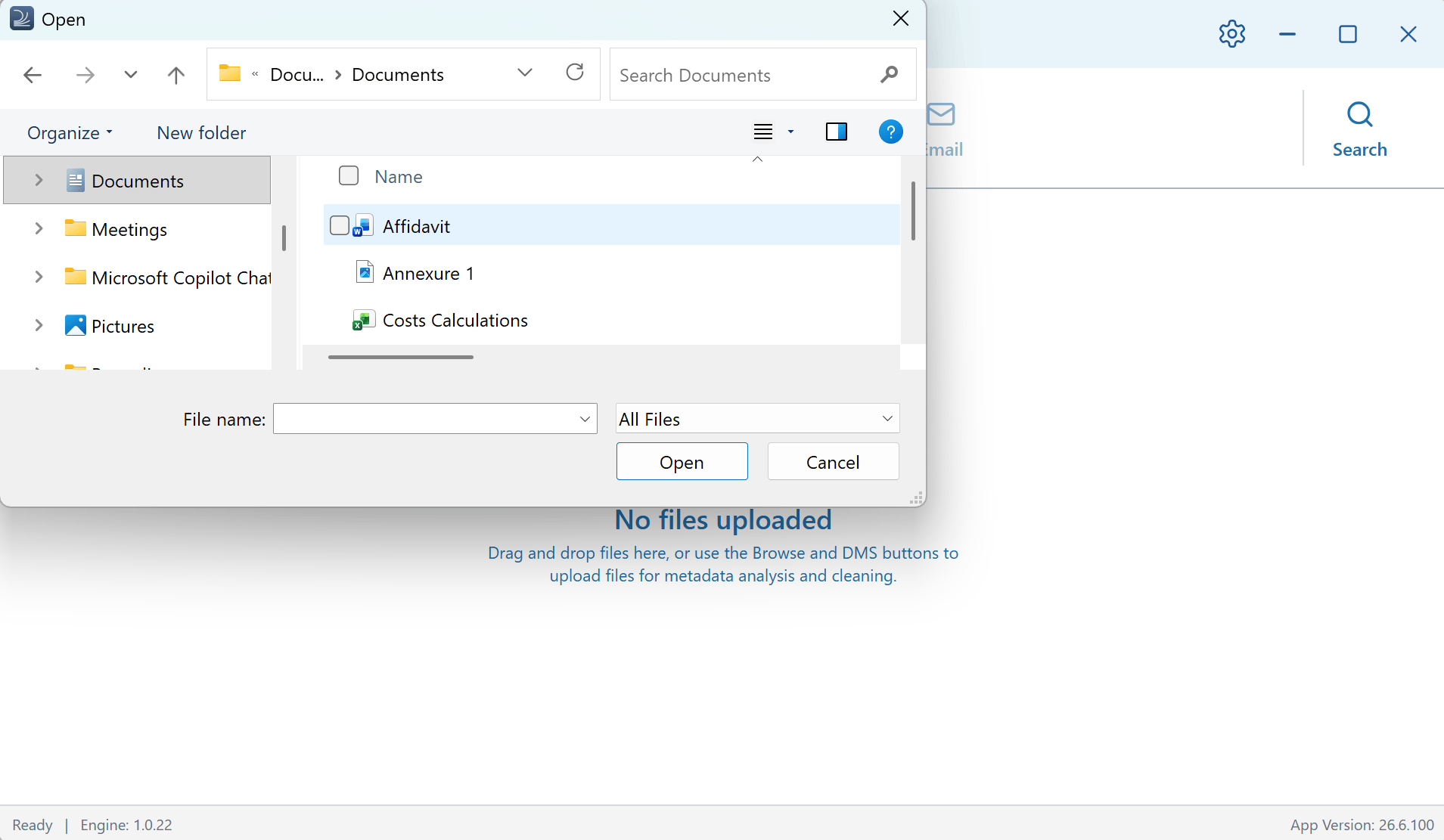
2
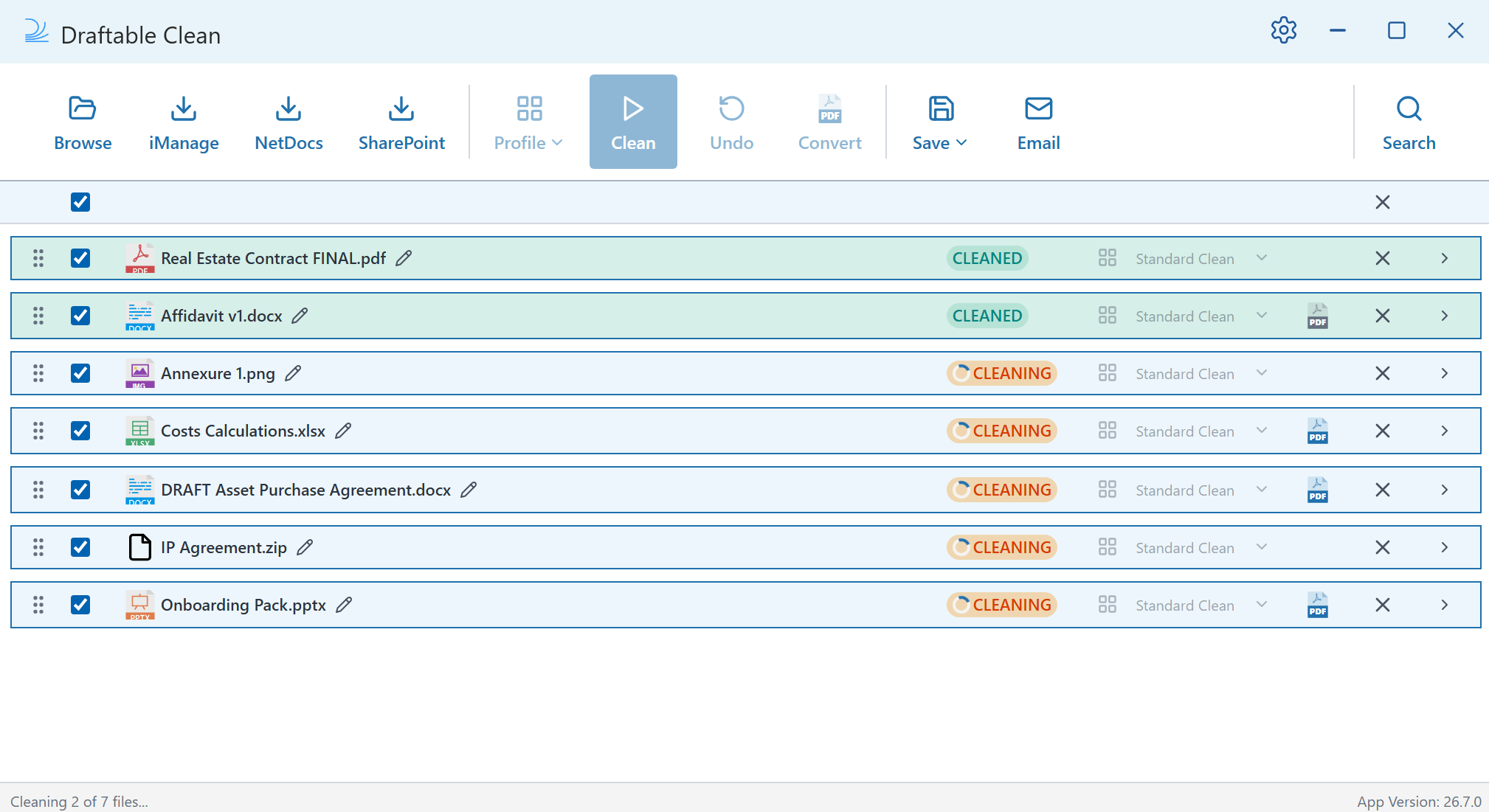
CLEAN: Once uploaded, files are automatically scanned and assigned a risk rating. When you are ready, click Clean in the toolbar. All selected files are cleaned and their status changes to CLEANED.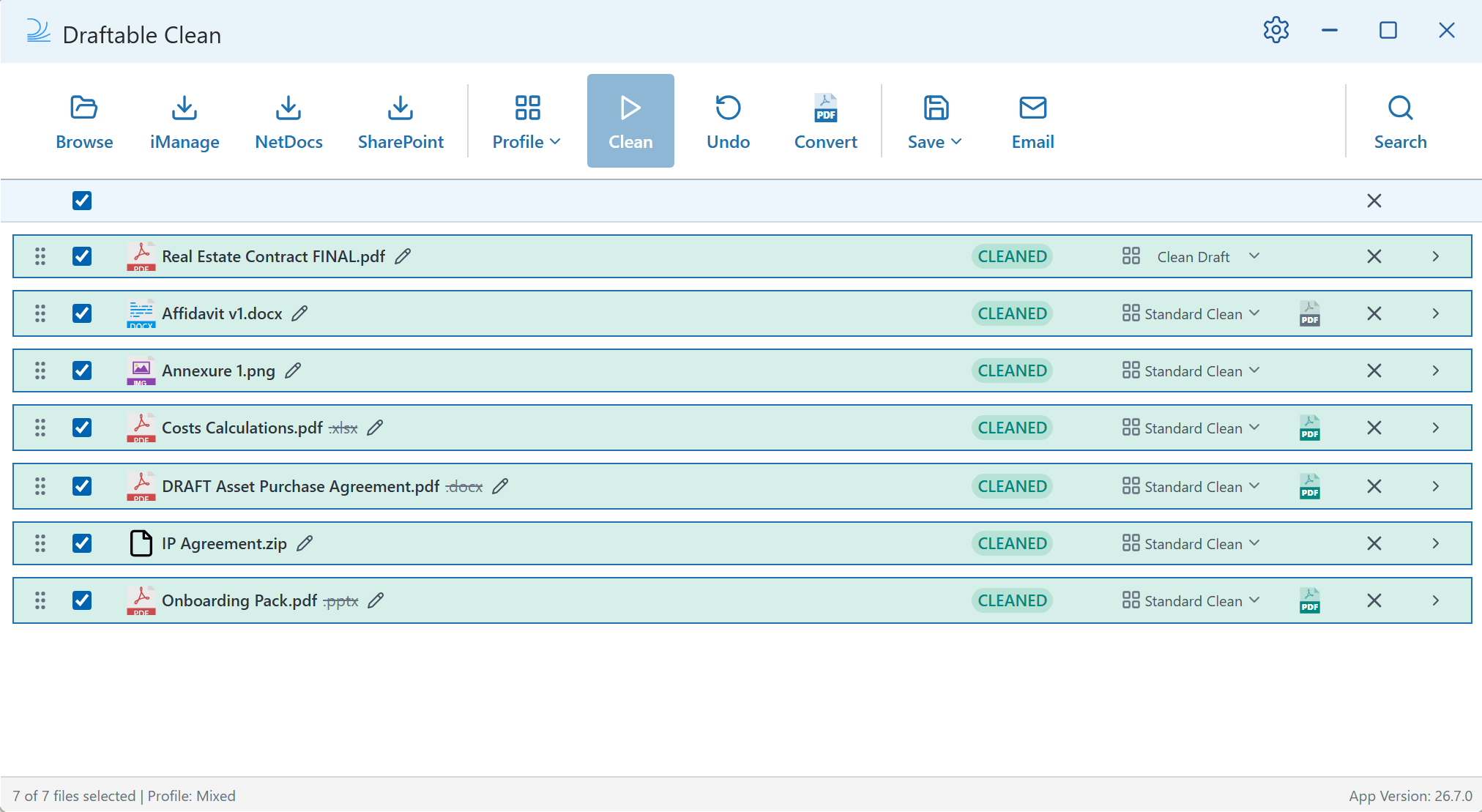
3
EXPORT: Save or share your cleaned files from the toolbar.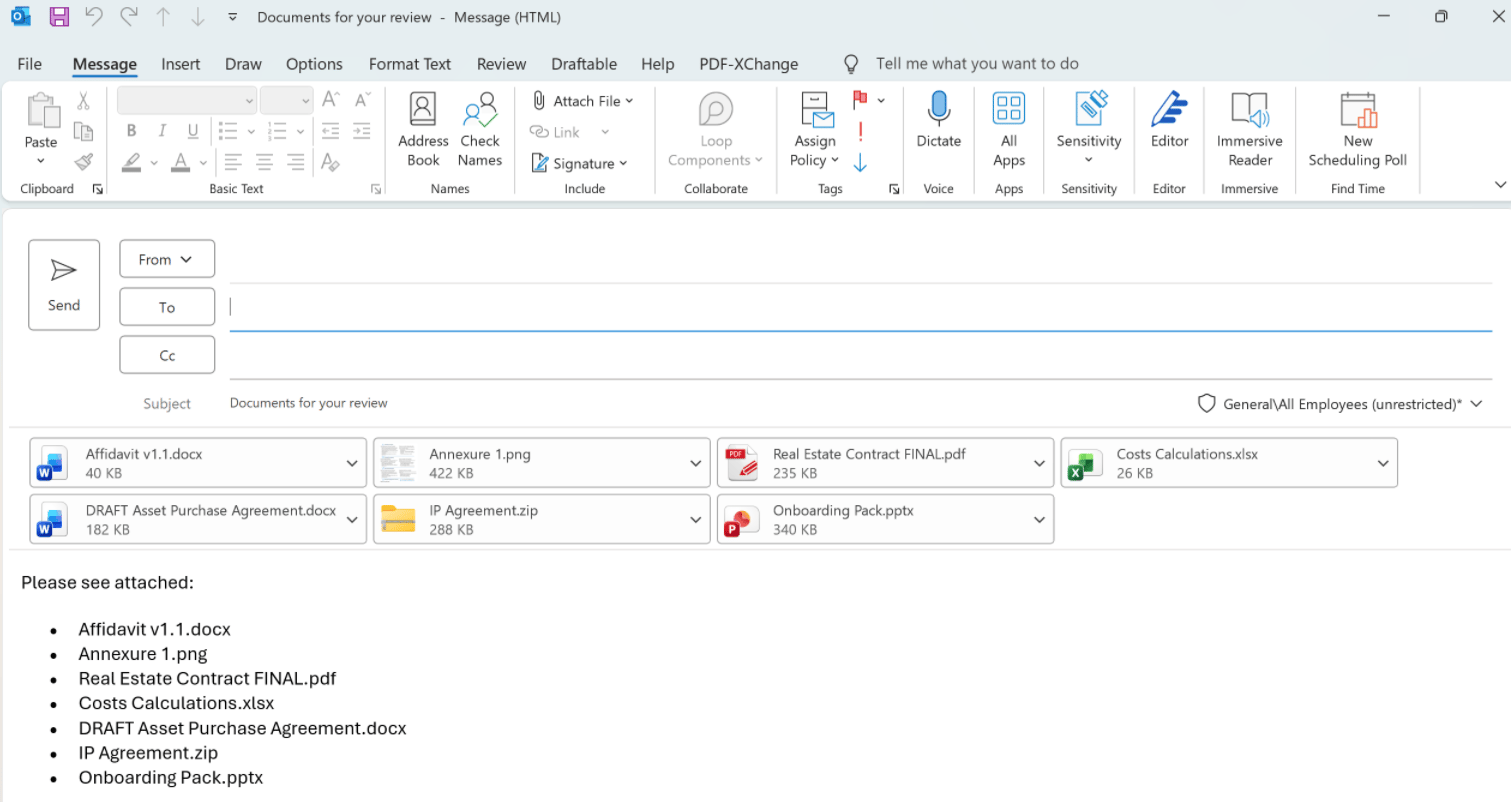
.png?fit=max&auto=format&n=UWnWsz4Ki4oPJdoe&q=85&s=4e59073b800249f8fa4abaa299e8d78d)
- Save — Save cleaned files to disk (packaged into a compressed ZIP folder with a timestamped filename) or back to your document management system (iManage, NetDocuments, or SharePoint).
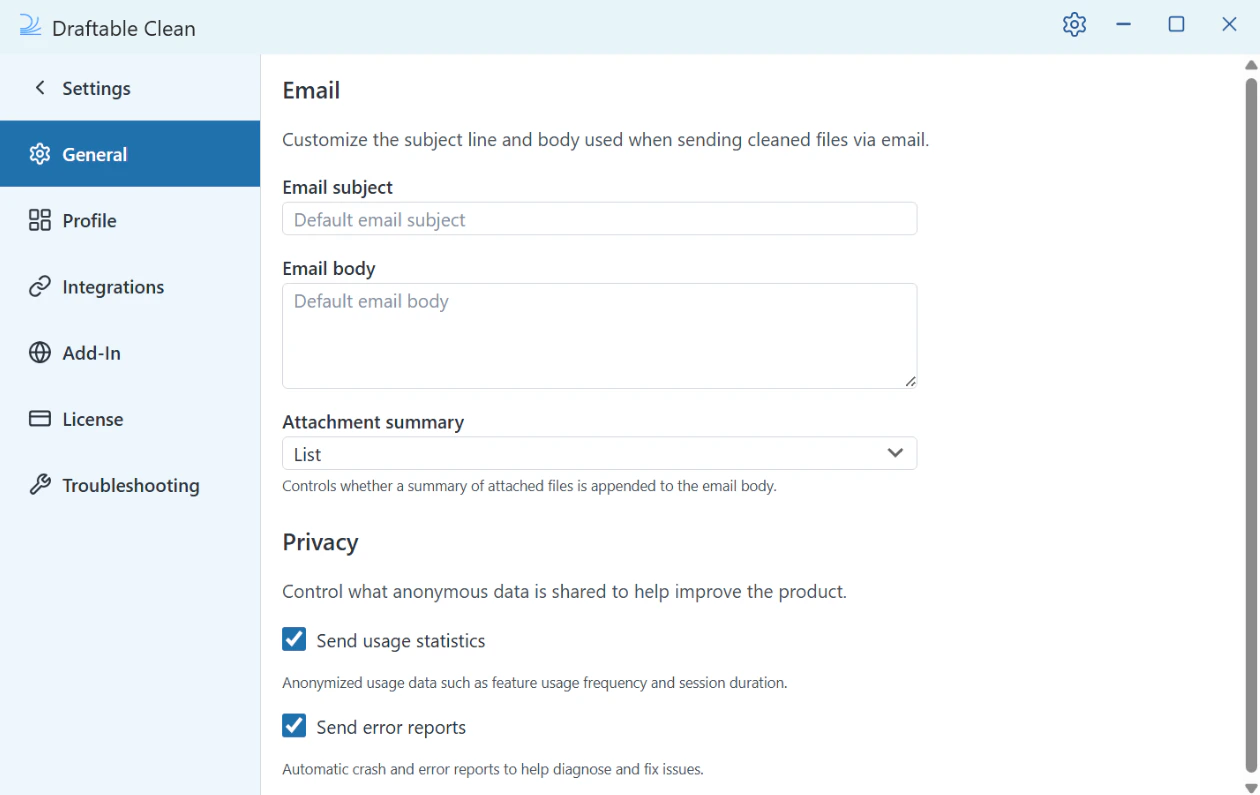
- Email — Opens a new Outlook message with your cleaned files pre-attached. Draftable Clean preserves file order and any filenames you have renamed. As of v26.7.0, the subject and body are left blank unless a default has been configured in Settings > General.
- Save (one by one) — Select where you would like each file to be saved individually.
- Save all to folder — Select a folder to save all cleaned files into as new files.
Saving as a new version to NetDocuments or SharePoint:
- NetDocuments — Select Save (one by one) and tick the Save as new version box when each file’s dialog box appears.
- SharePoint — Save the file into the destination folder using the same name as the existing file. For example, saving
document.docxinto a folder that already containsdocument.docxsaves it as a new version; using a different name saves it as a new file.
Configuring email defaults
In Settings > General, you can prepare defaults for emails sent from the desktop application:- Email subject — The default subject line
- Email body — The default body text
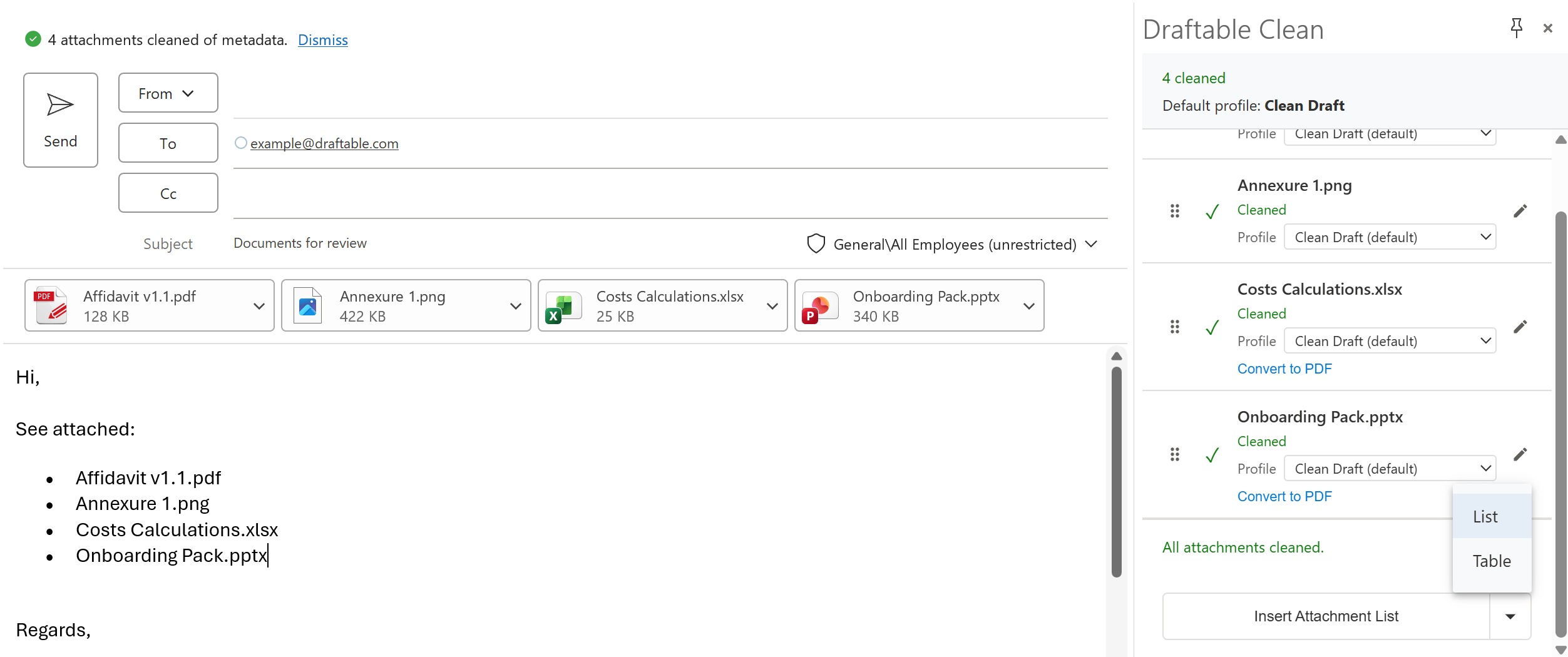
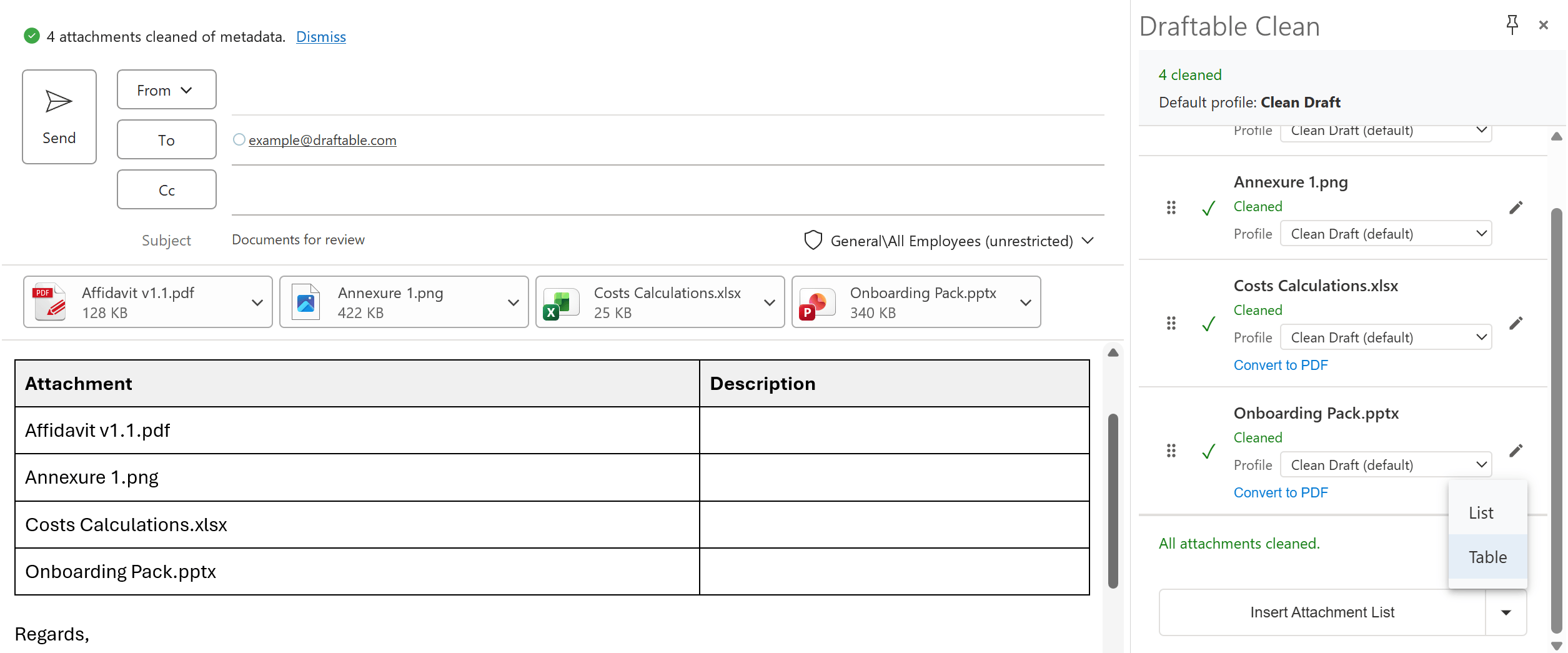
- Attachment summary — Whether a List (bullet points) or Table (with columns) of attachments is inserted into the email body
Password-protected files
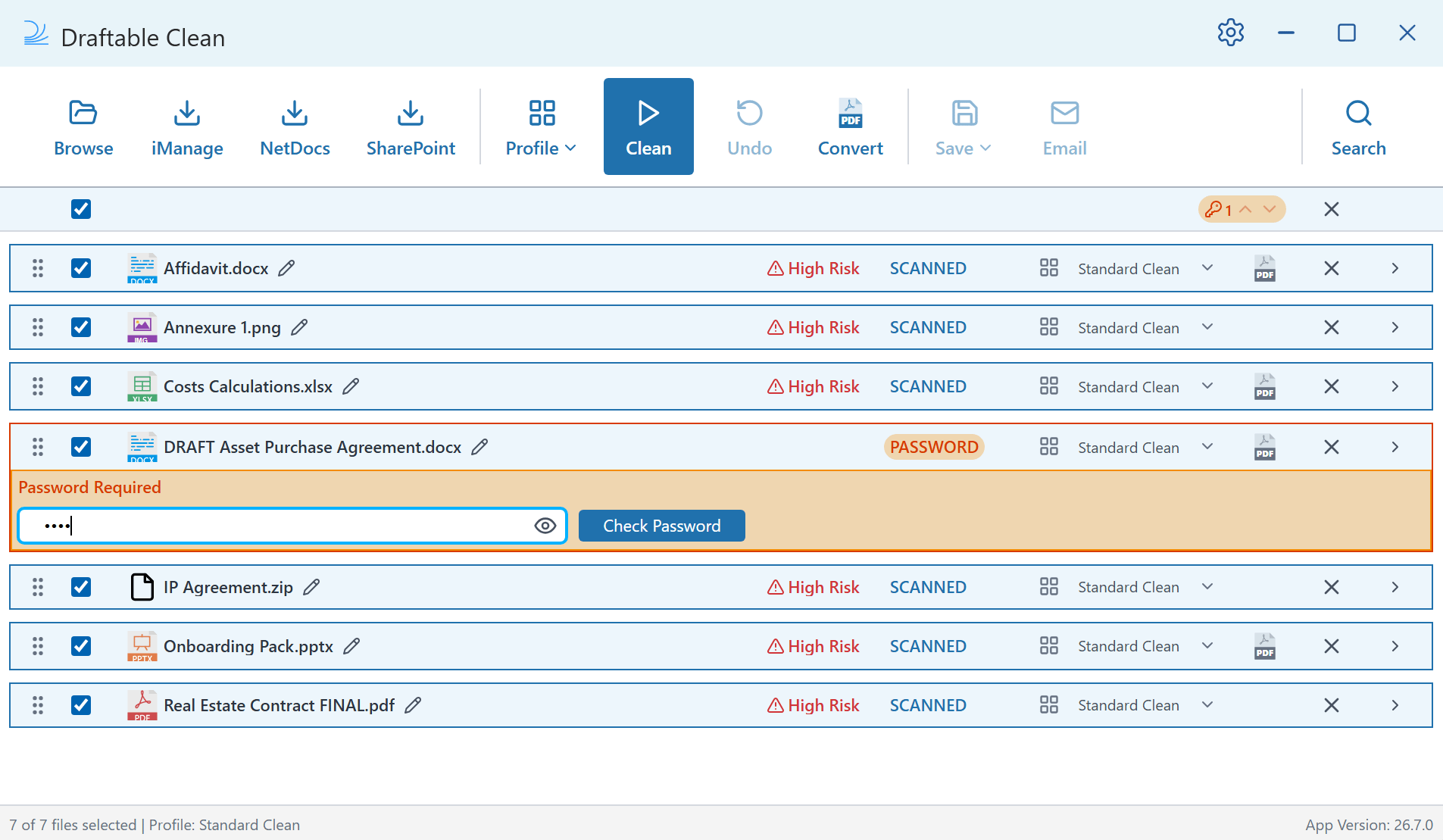
If a file shows a PASSWORD status (highlighted in orange), it is password-protected and cannot be scanned until you provide the password. A Password Required prompt appears automatically below the file with a password field.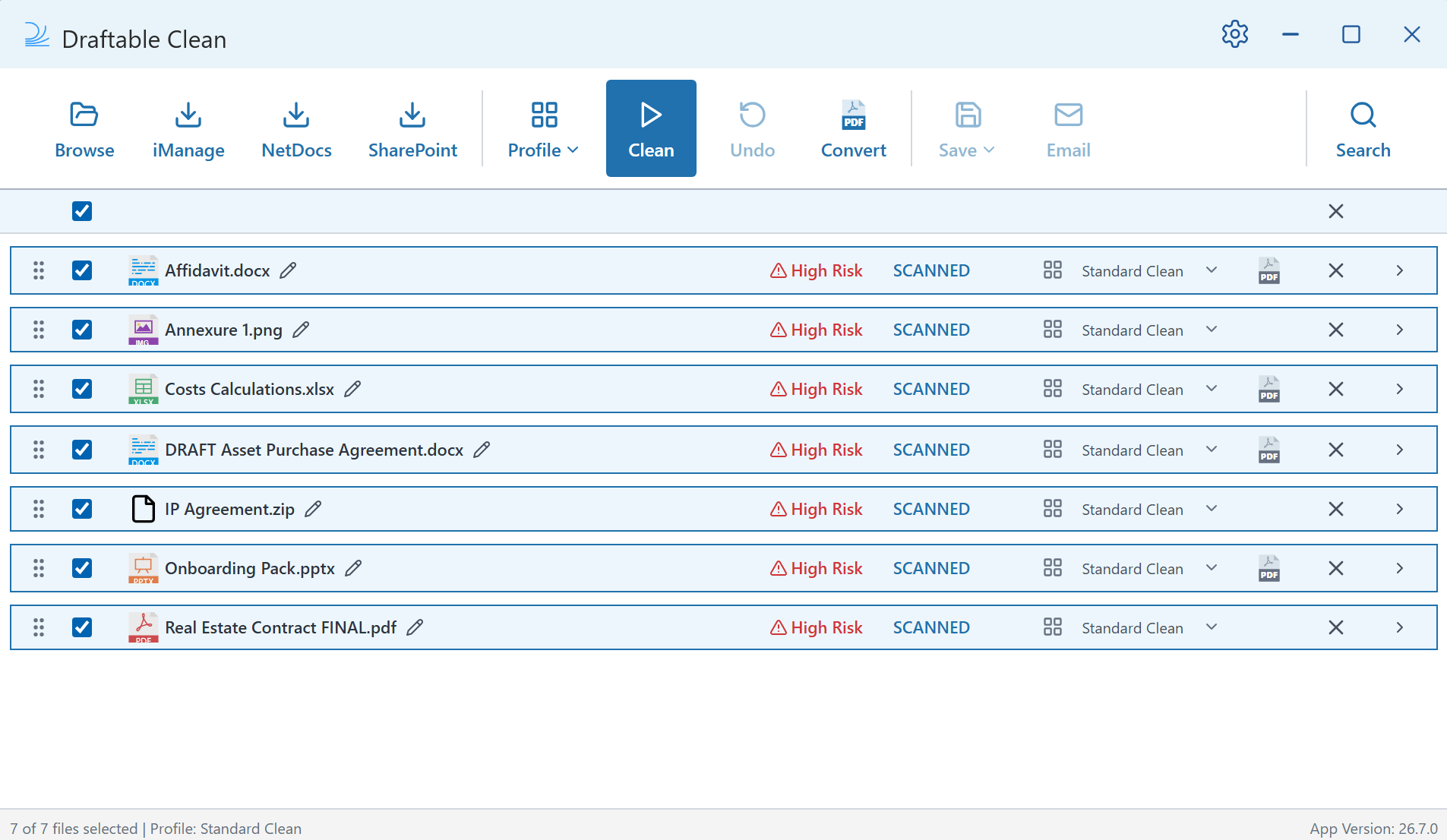
Reviewing metadata in files
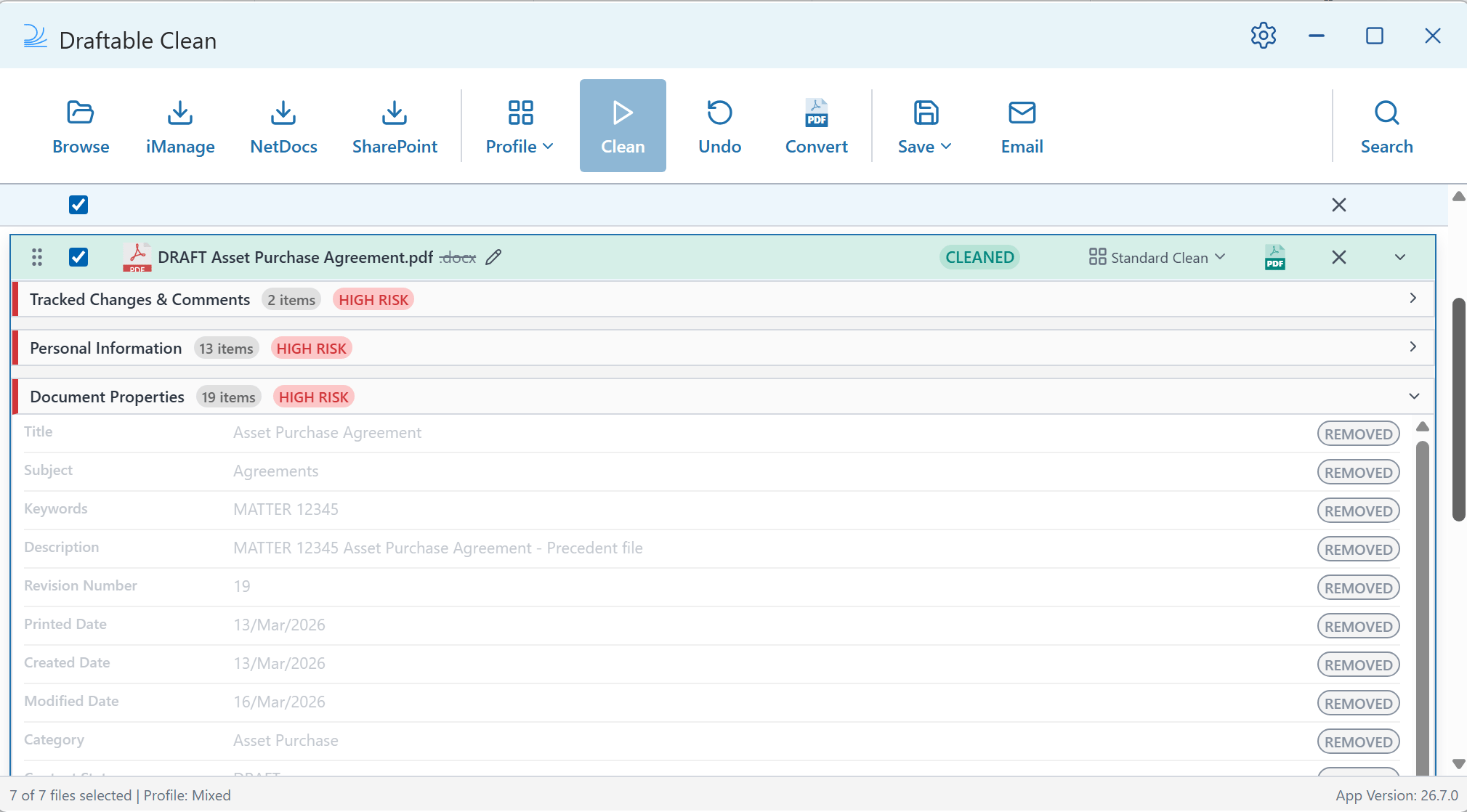
Click the expand arrow (>) on any file to see a detailed breakdown of its metadata. Metadata is grouped into categories — such as Document Properties, Personal Information, Tracked Changes & Comments, and more — each with their own item count and risk level.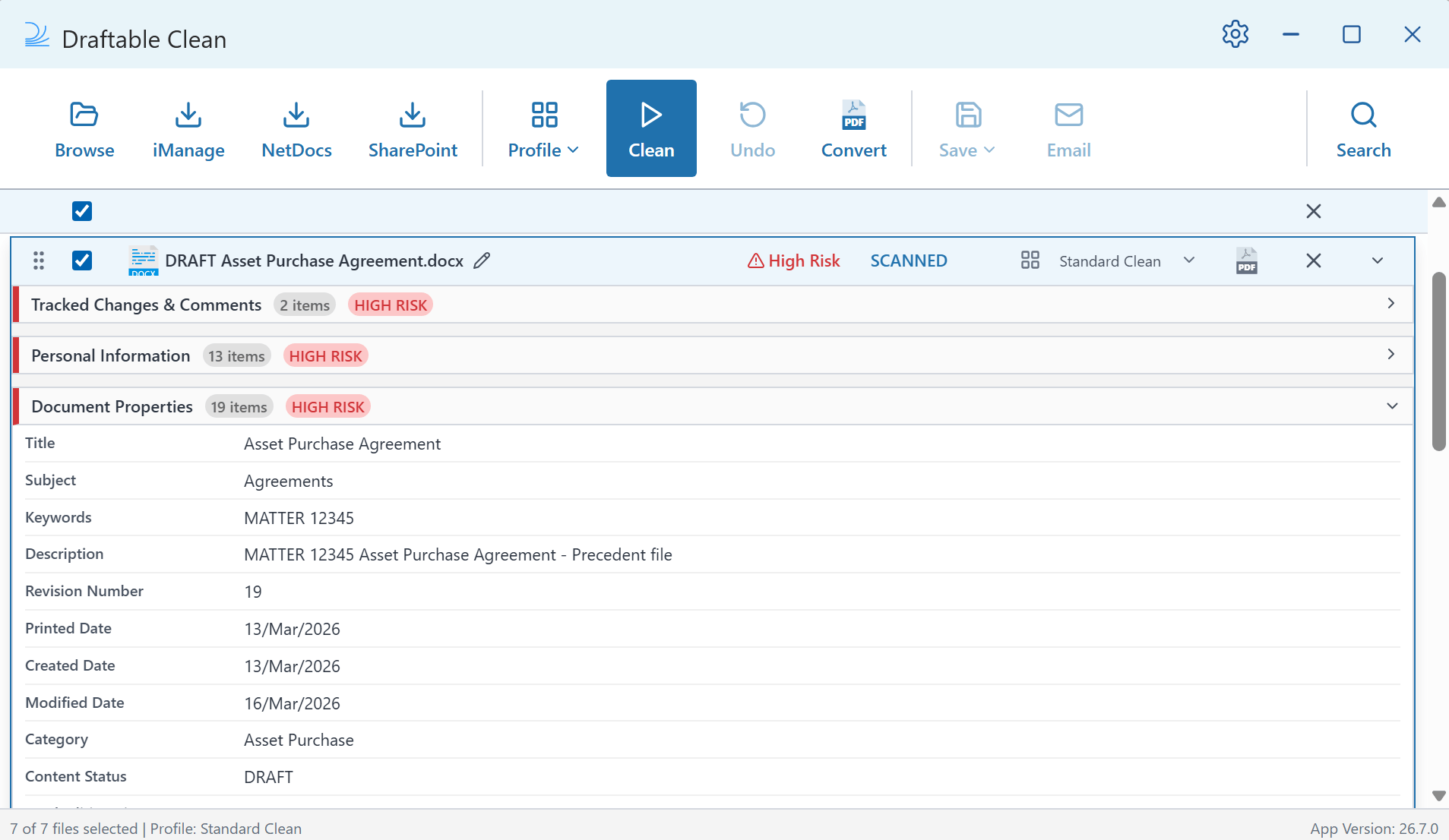
Searching metadata in files
Use the search bar above the file list to find specific metadata across all loaded files. This helps you locate particular fields — such as author names or tracked changes — before you clean or export.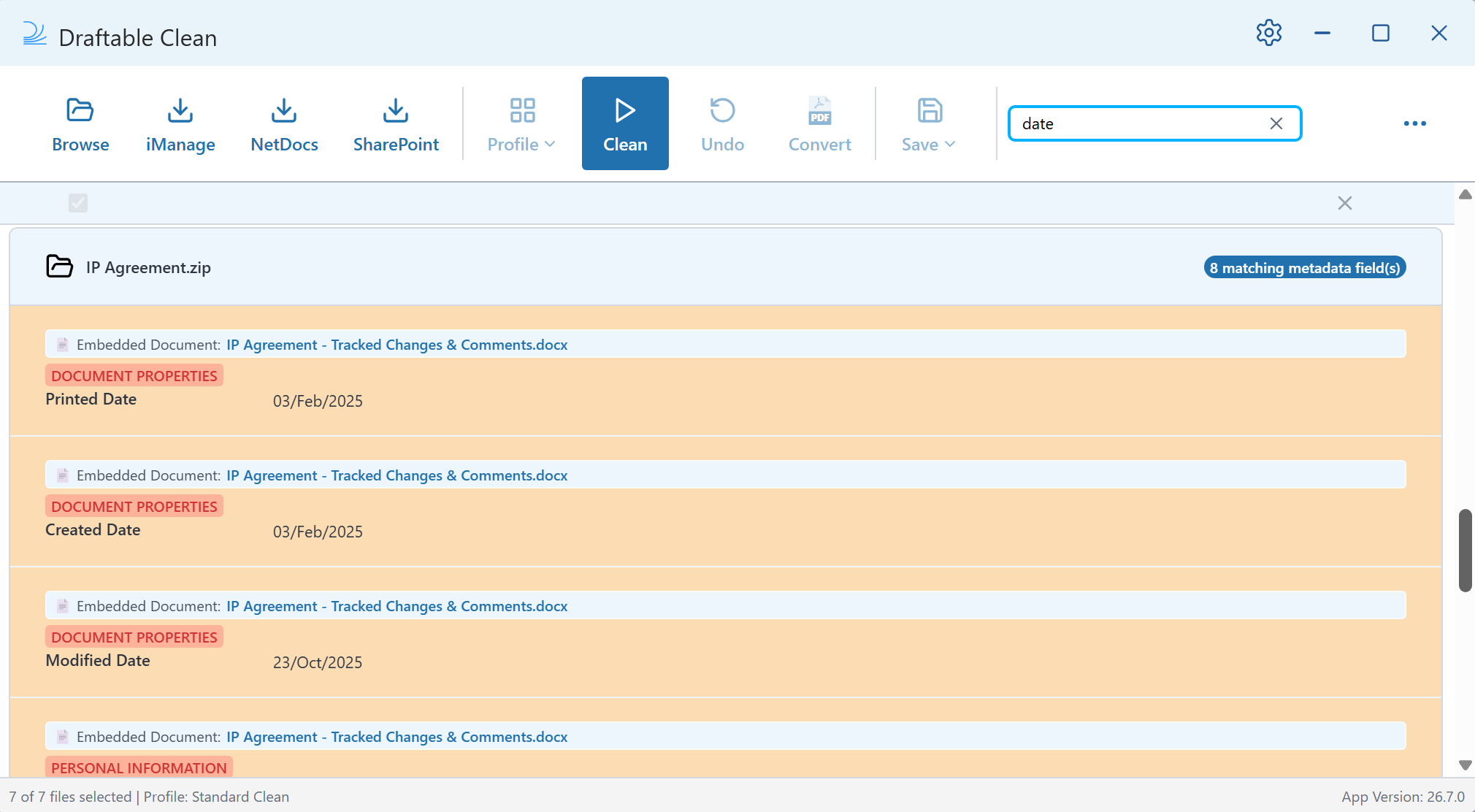
Renaming and reordering files
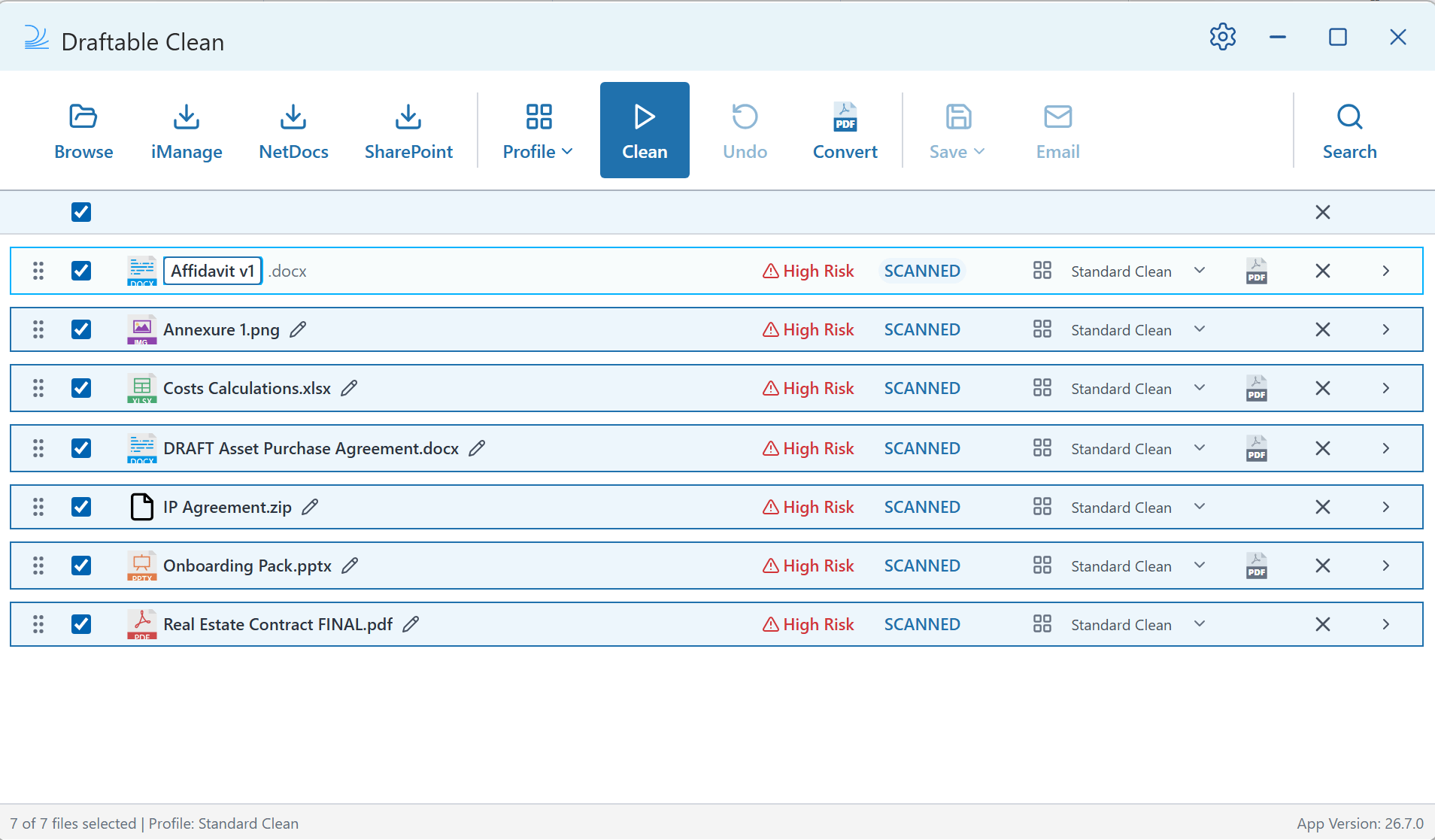
Rename and reorder files directly in the file list before cleaning:- Rename — Click the pencil icon next to a file name to edit it inline. Press Enter or click away to confirm.
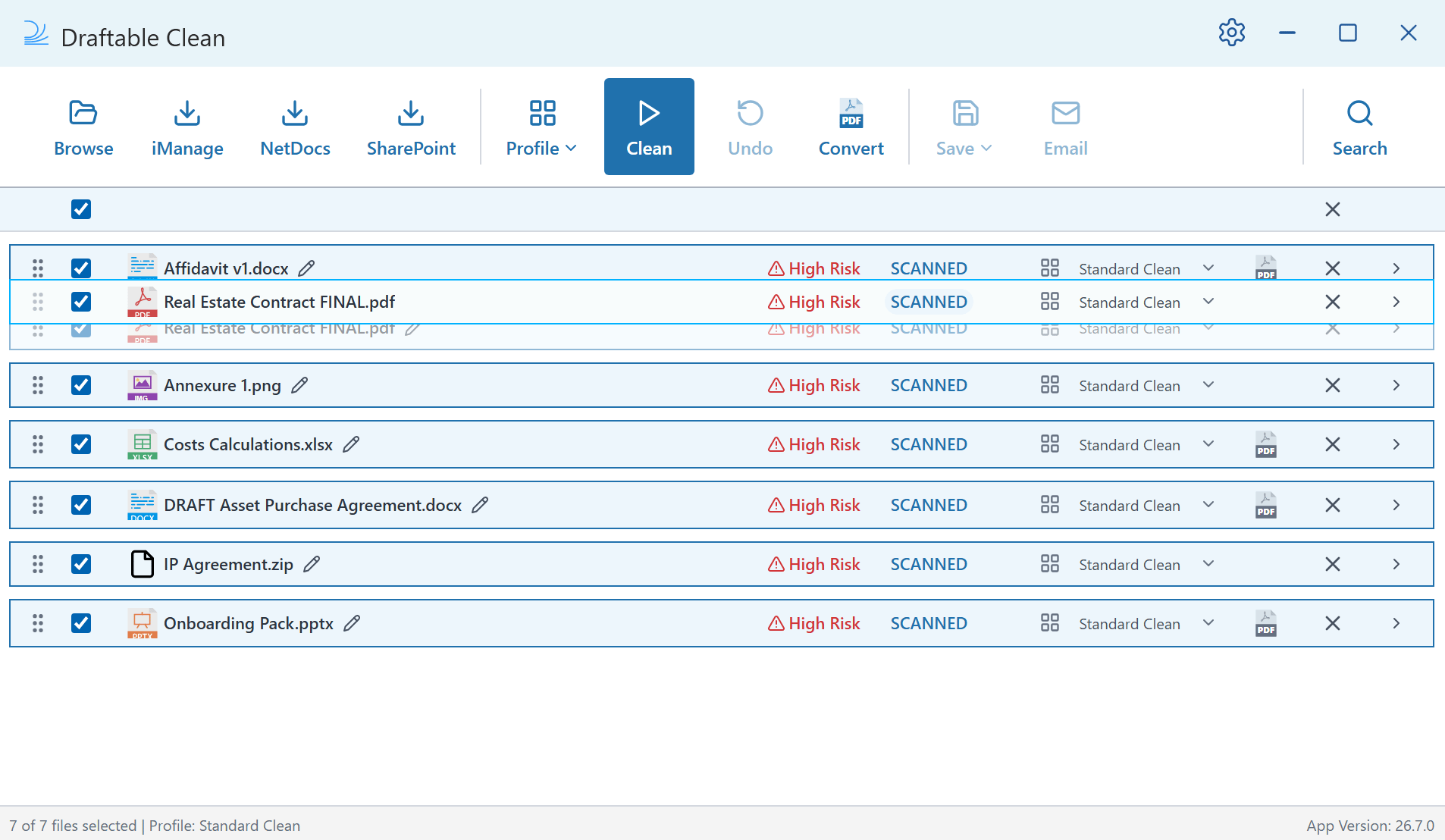
- Reorder — Drag files up or down in the list to change the attachment order.
Converting to PDF
Before cleaning, you can optionally flag supported files for conversion to PDF. Click the PDF icon inline with a file to flag it — the icon turns blue when flagged. Alternatively, select one or more files and click Convert in the toolbar to flag them for conversion. Flagged files are converted when you click Clean. You can flag or unflag files for conversion before or after cleaning.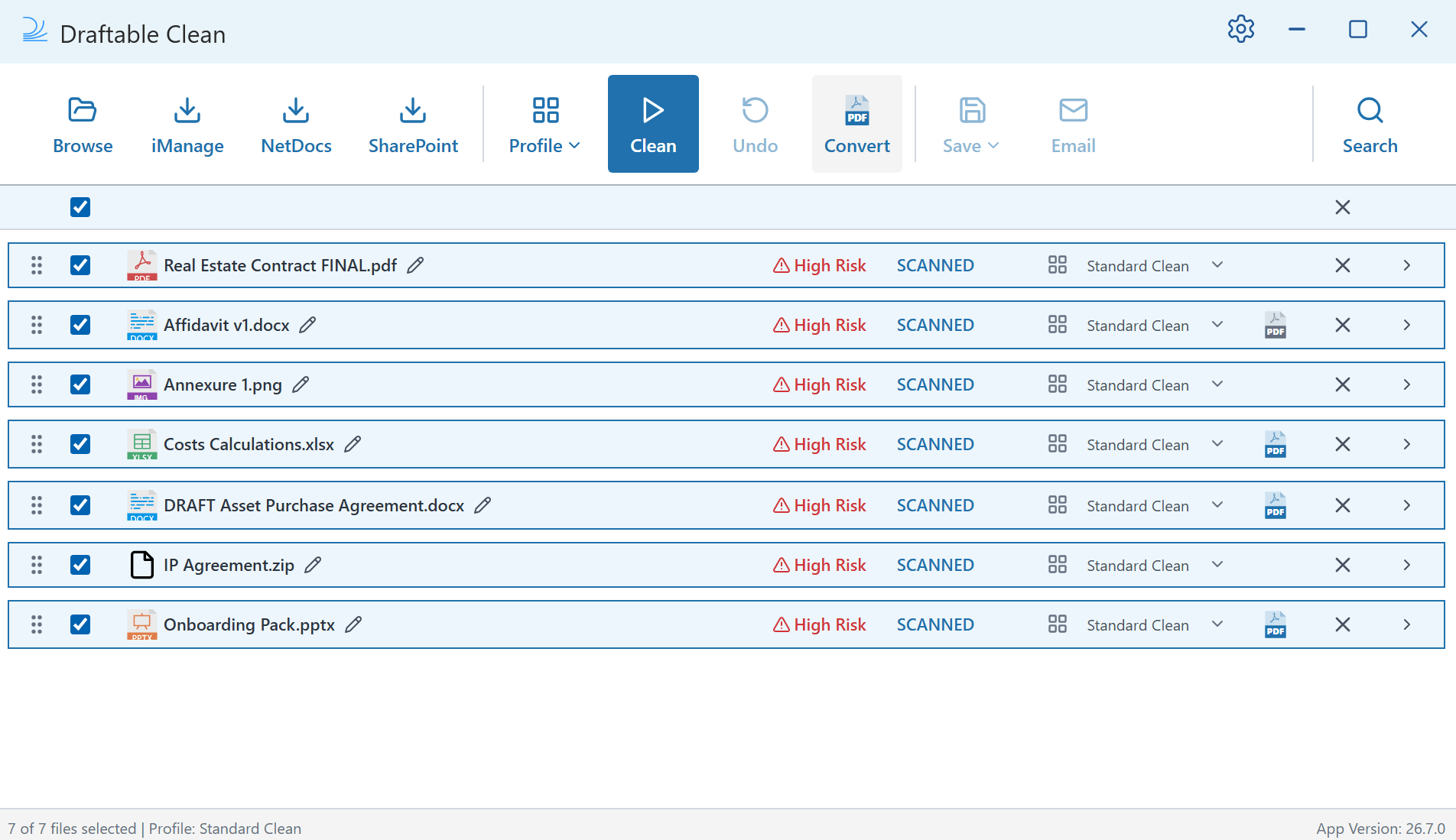
Part 2: Draftable Clean Outlook add-in
The Draftable Clean add-in runs directly inside Microsoft Outlook and automatically cleans attachments as you compose emails. Attach files and compose your email as you normally would, then click Send. Draftable Clean cleans your attachments in the background according to your organization’s policies — you can send with confidence that your files have been cleaned.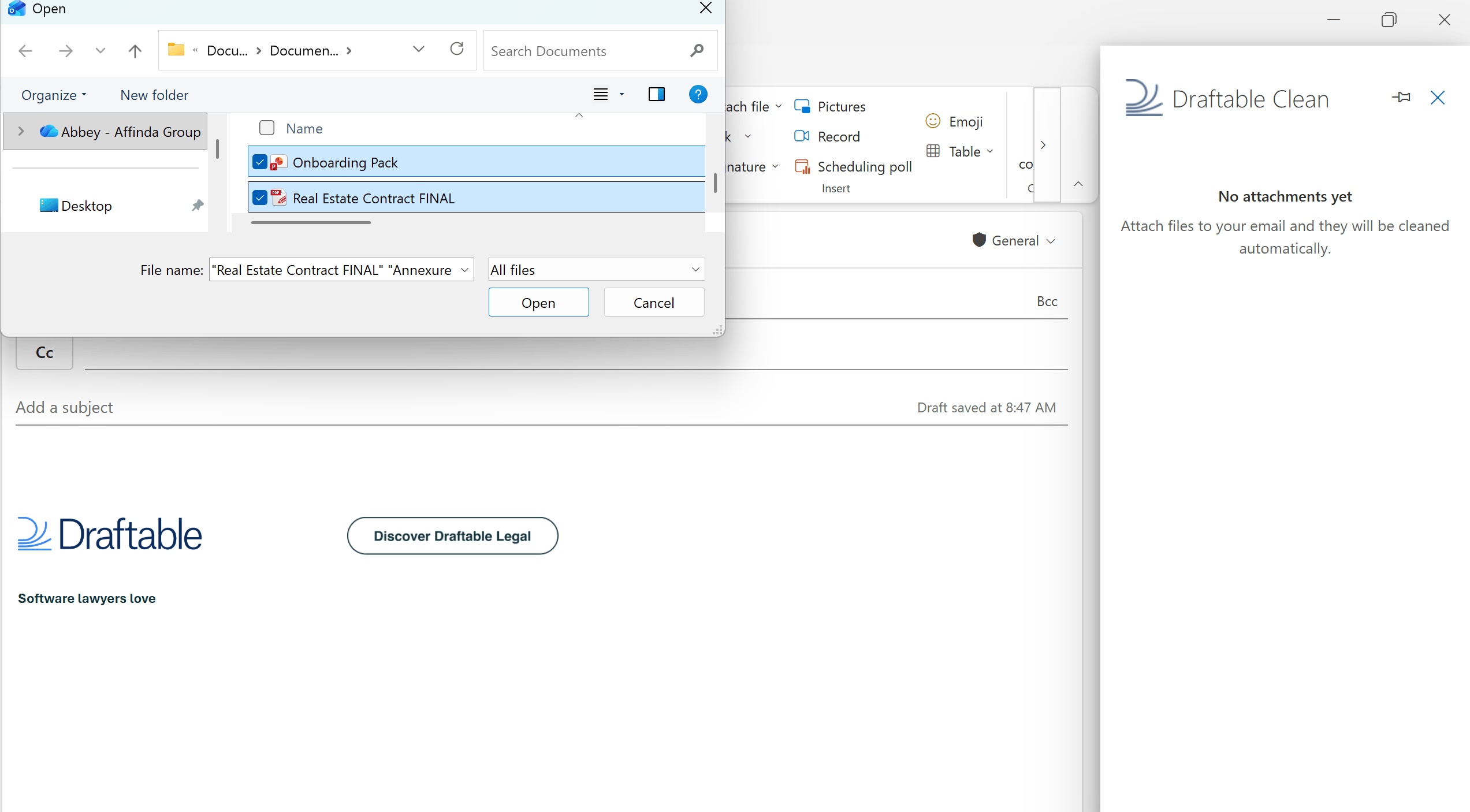
The desktop application must be running for the add-in to function. If it is not already open, the add-in will attempt to launch it silently in the background.
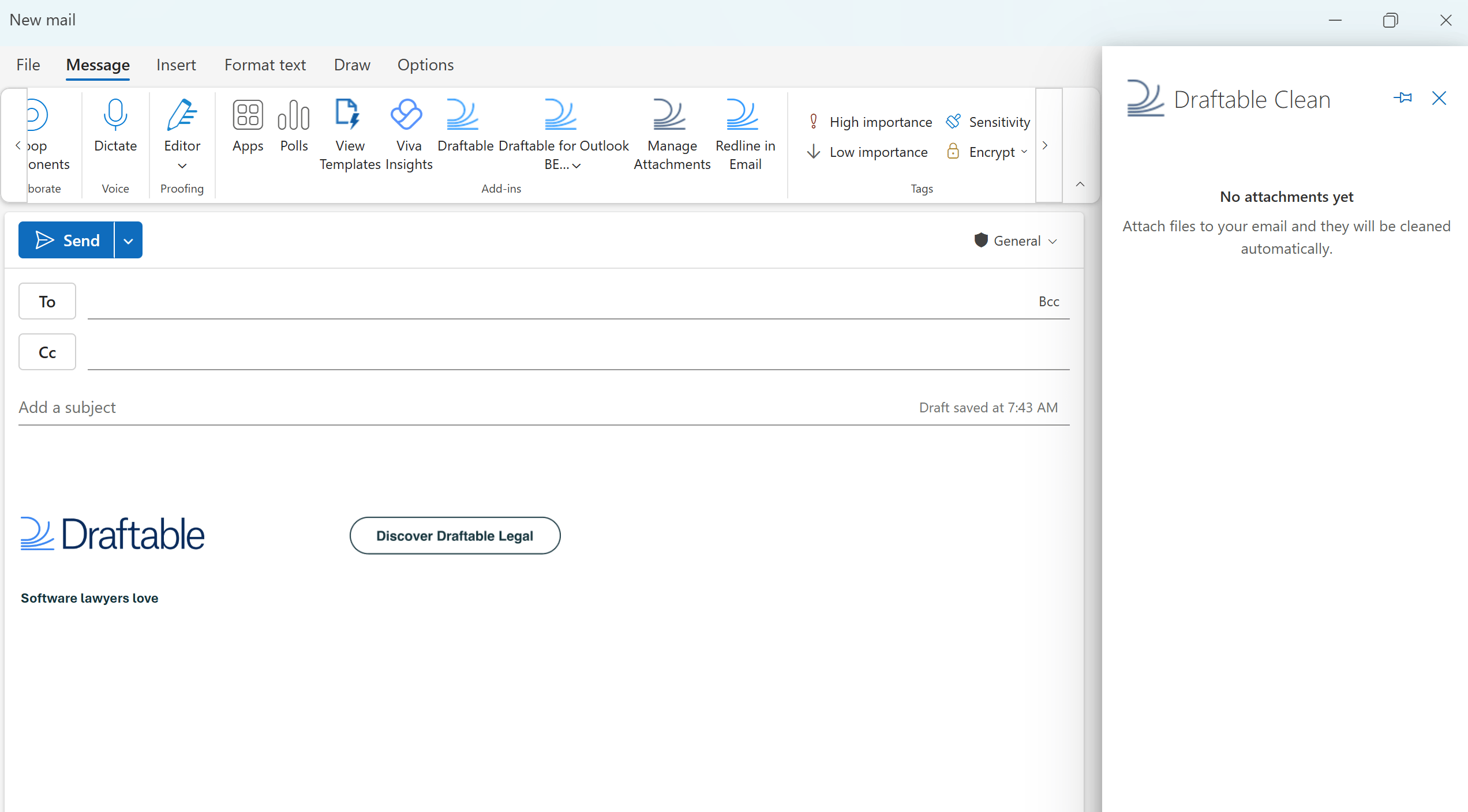
In Classic Outlook, you must pin the Draftable Clean pane and keep it open for files to be cleaned. In New Outlook, the pane does not need to be open — you can attach files and send without opening the panel.
Changing the add-in language
Draftable Clean supports multiple languages including English, Deutsch, Español, Français, 日本語, Nederlands, Polski, Português, Svenska, and Tagalog. Open the add-in pane and click the globe icon at the bottom of the panel to select your preferred language.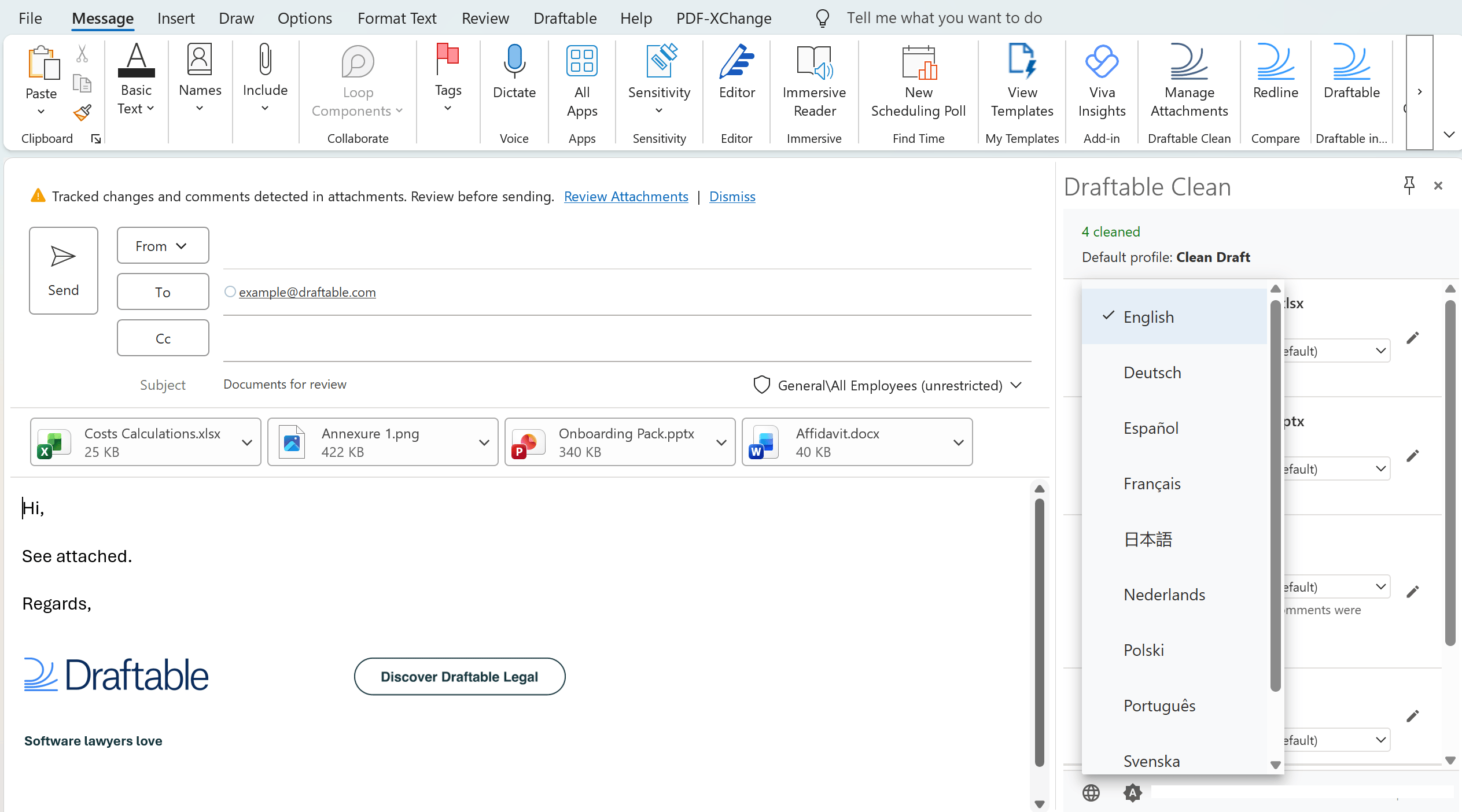
Automatic profile switching based on recipients
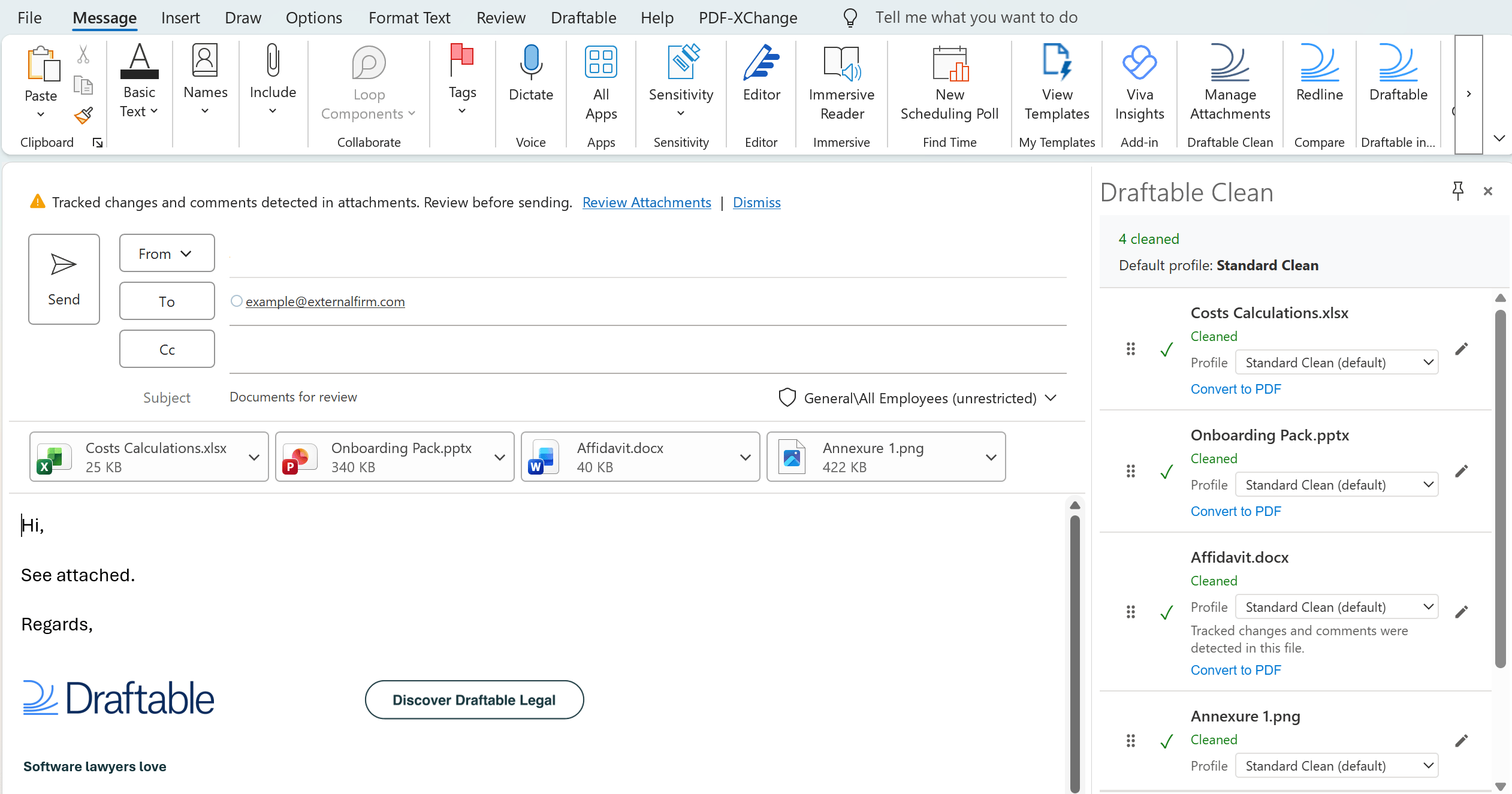
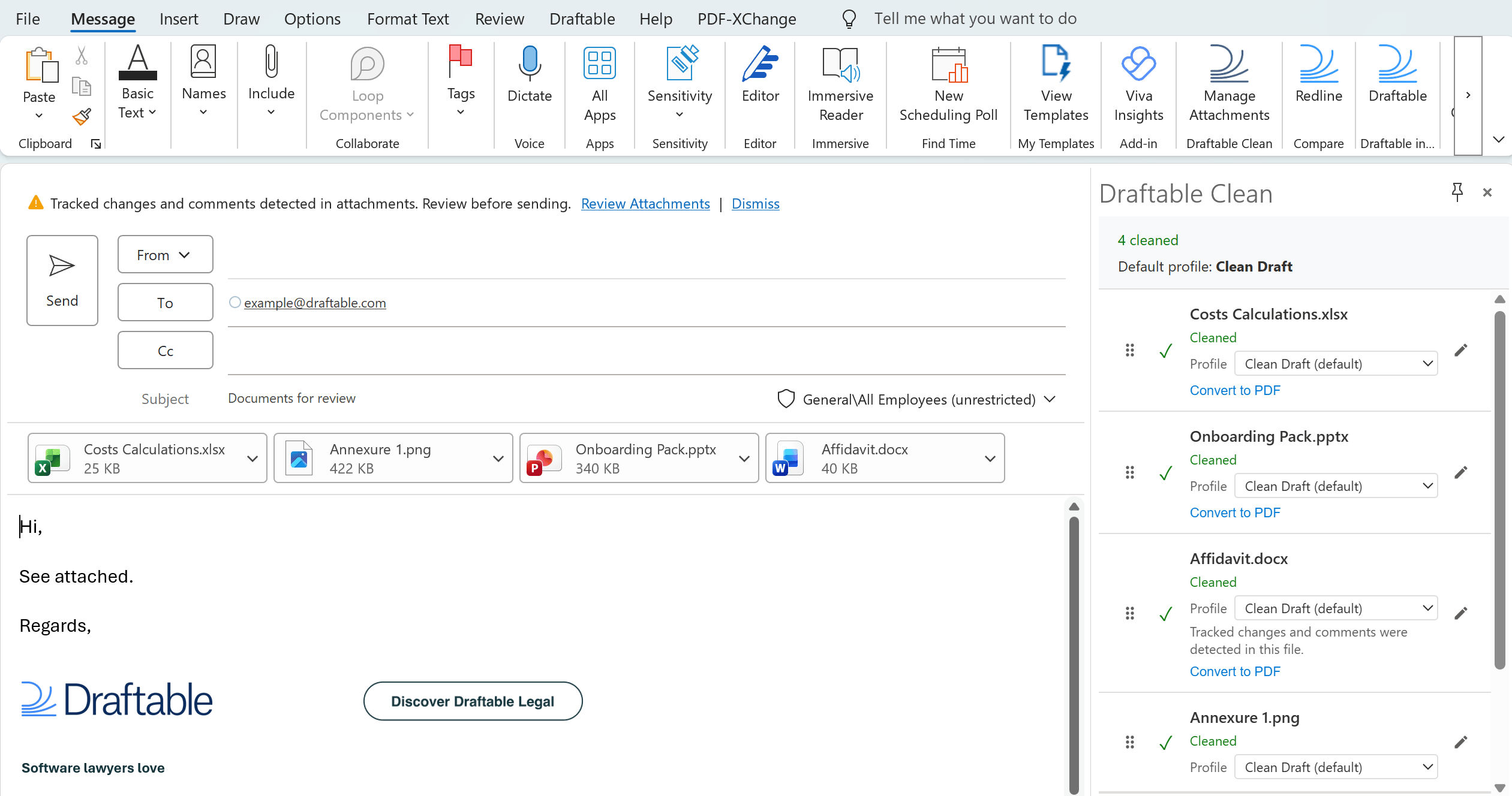
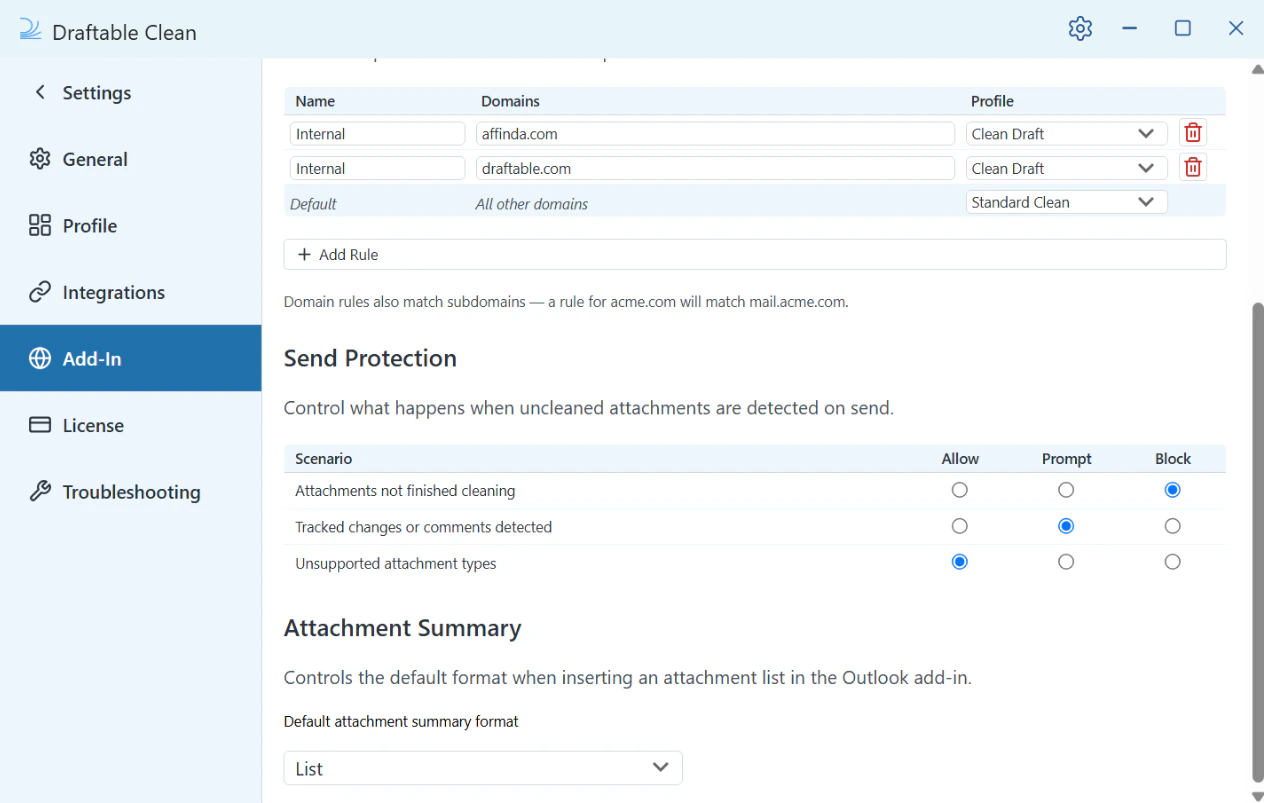
Draftable Clean intelligently adjusts the cleaning profile based on recipient email domains. Domain rules are configured in Settings > Add-In and determine which cleaning profile is applied. For example, a typical configuration might be:- No recipients entered — A default profile such as Standard Clean is used
- Internal recipients (e.g.
colleague@yourfirm.com) — A lighter profile such as Clean Draft that preserves tracked changes and comments - External recipients (e.g.
contact@externalfirm.com) — A stricter profile such as Standard Clean
Updating the file profile
If enabled by your administrator in Settings > Add-In, you can override the cleaning profile for individual files using the per-file Profile dropdown in the add-in pane.Converting attachments to PDF
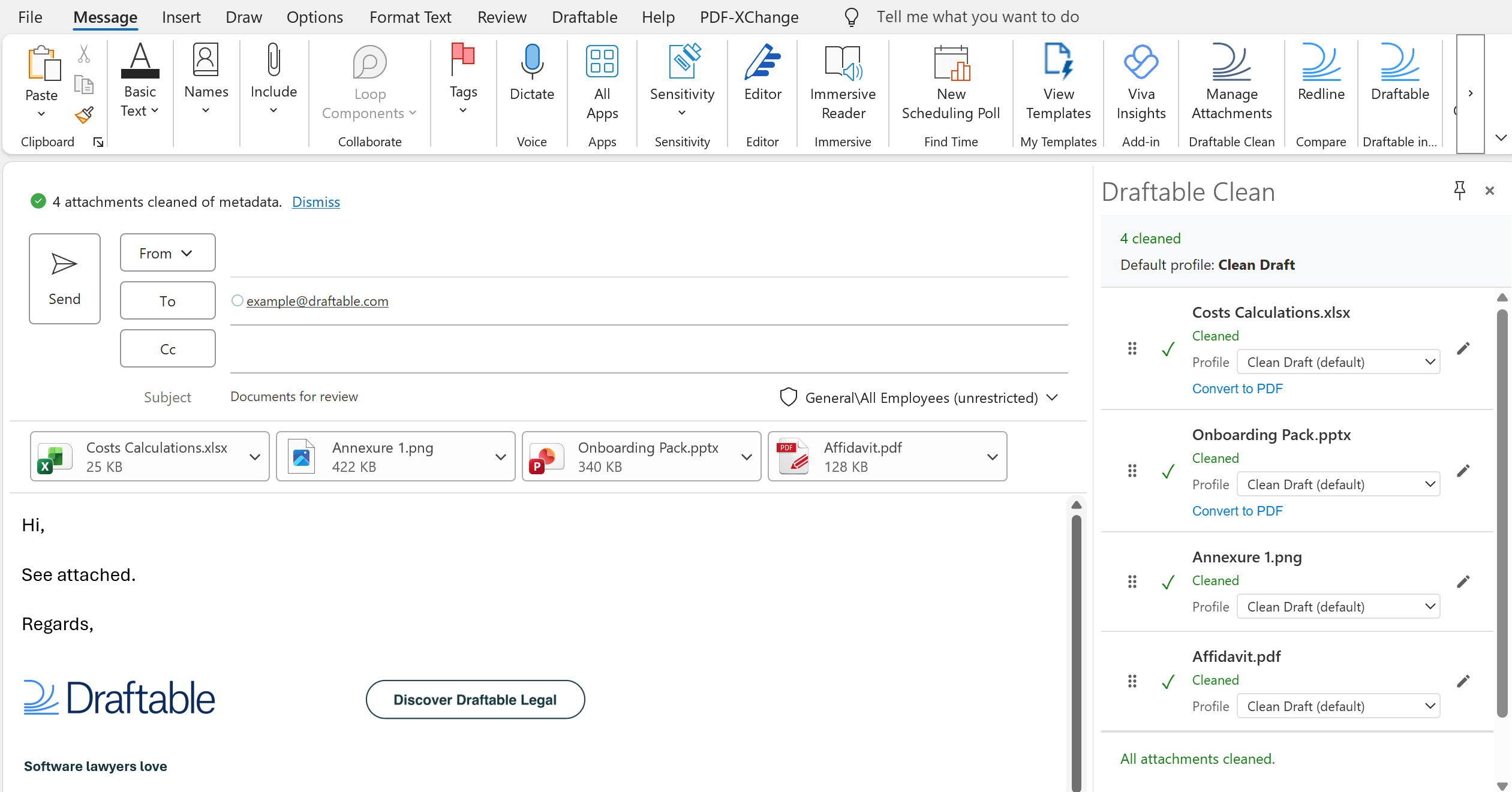
Supported Word, Excel, and PowerPoint attachments can be converted to PDF from the add-in panel. Click Convert to PDF on an attachment to flag it — the file is converted automatically when cleaning completes..png?fit=max&auto=format&n=ku8YqcThAWDOA_hT&q=85&s=1b5abe938503aa2c64492e6b3b689baa)
Renaming attachments
After cleaning, you can rename files directly in the Draftable Clean panel. Click the pencil icon next to a file name to edit it inline.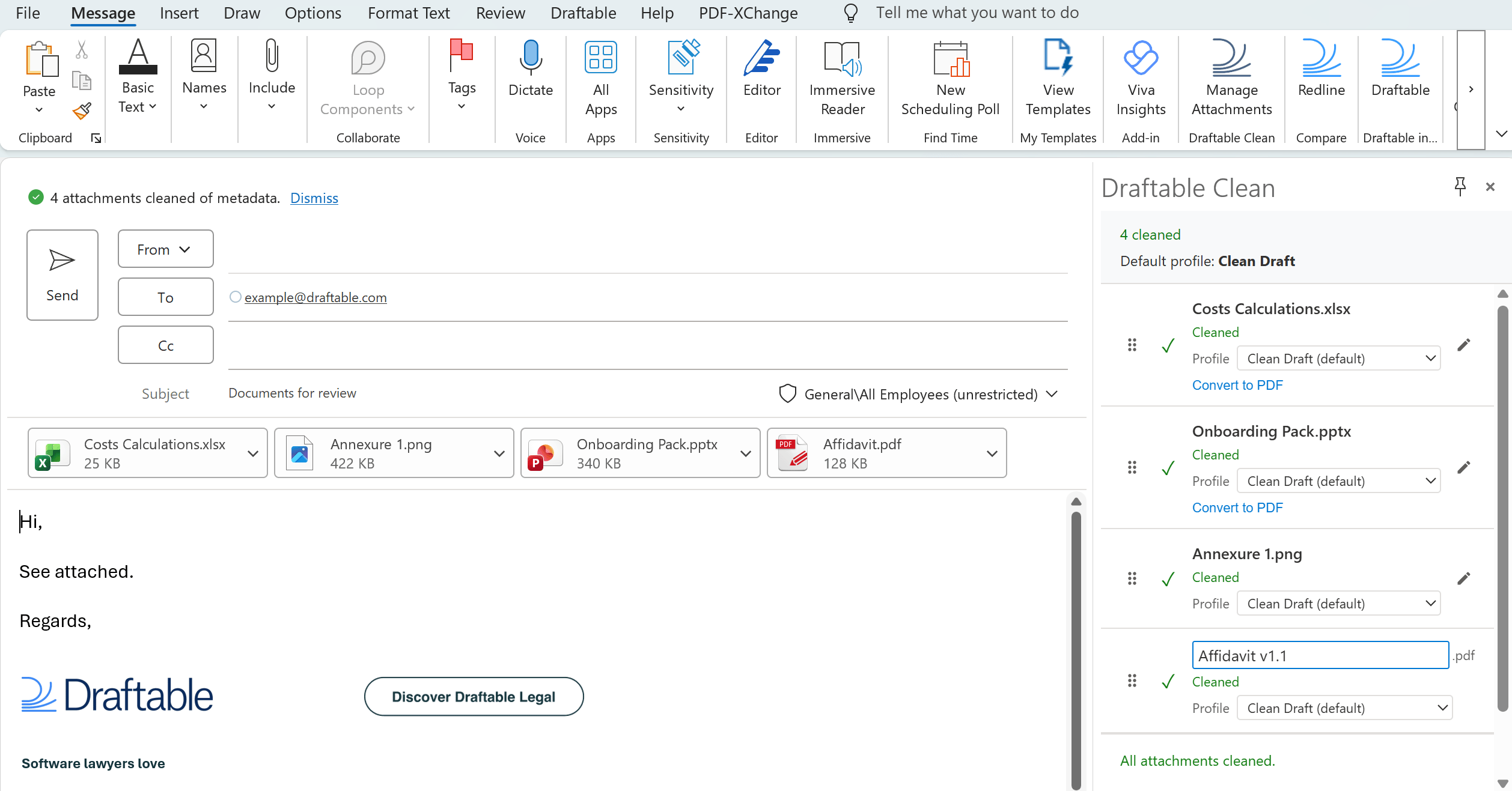
Unsupported file types
If you attach a file in a format Draftable Clean does not support, the Draftable Clean panel displays an “Unsupported format” status with the message: “This file type cannot be cleaned. See Knowledge Base.” Unsupported files do not block sending by default — this behavior is configurable in Settings > Add-In > Send Protection.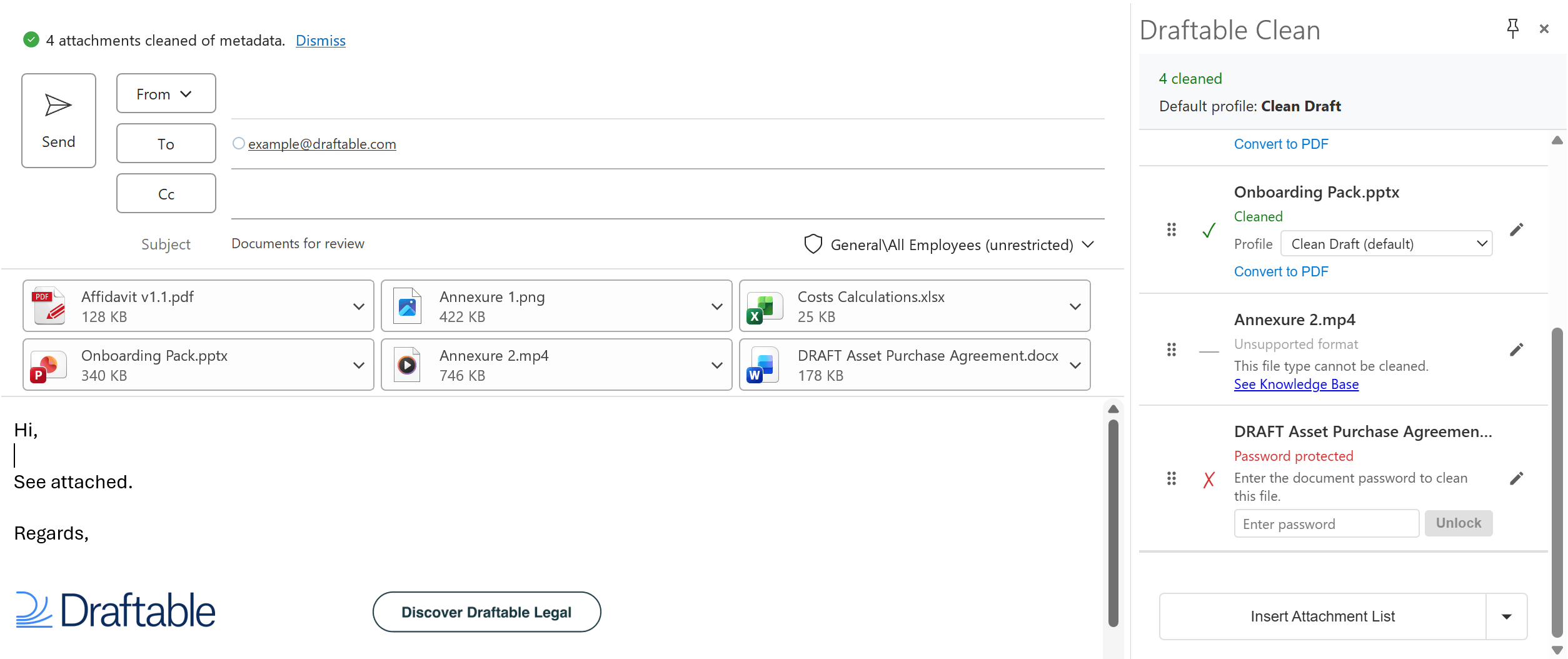
Password-protected files
If you attach a password-protected file, it shows an orange “Password protected” status with the message: “Enter the document password to clean this file.” Enter the password in the provided field and click Unlock to authenticate and clean the file. If the password is incorrect, an “Incorrect password. Please try again.” message is displayed. Re-enter the correct password and click Unlock again.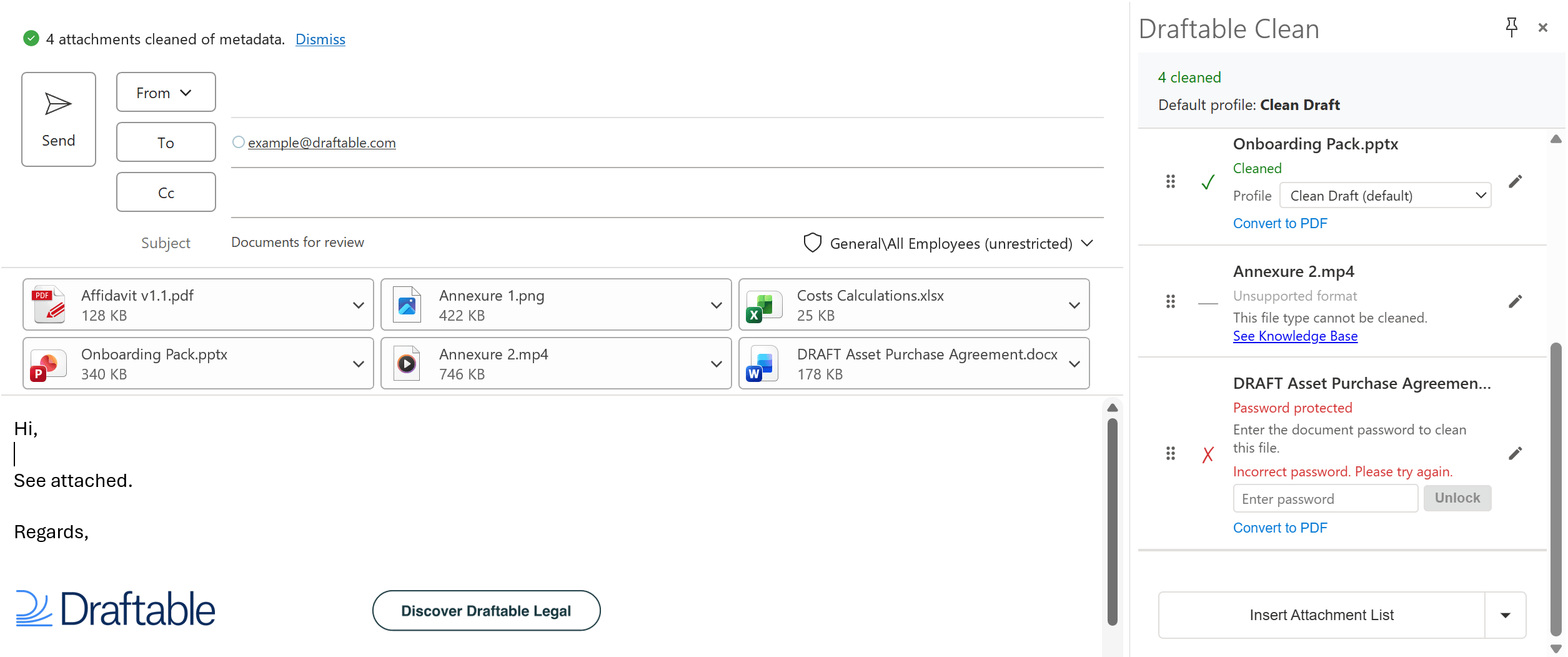
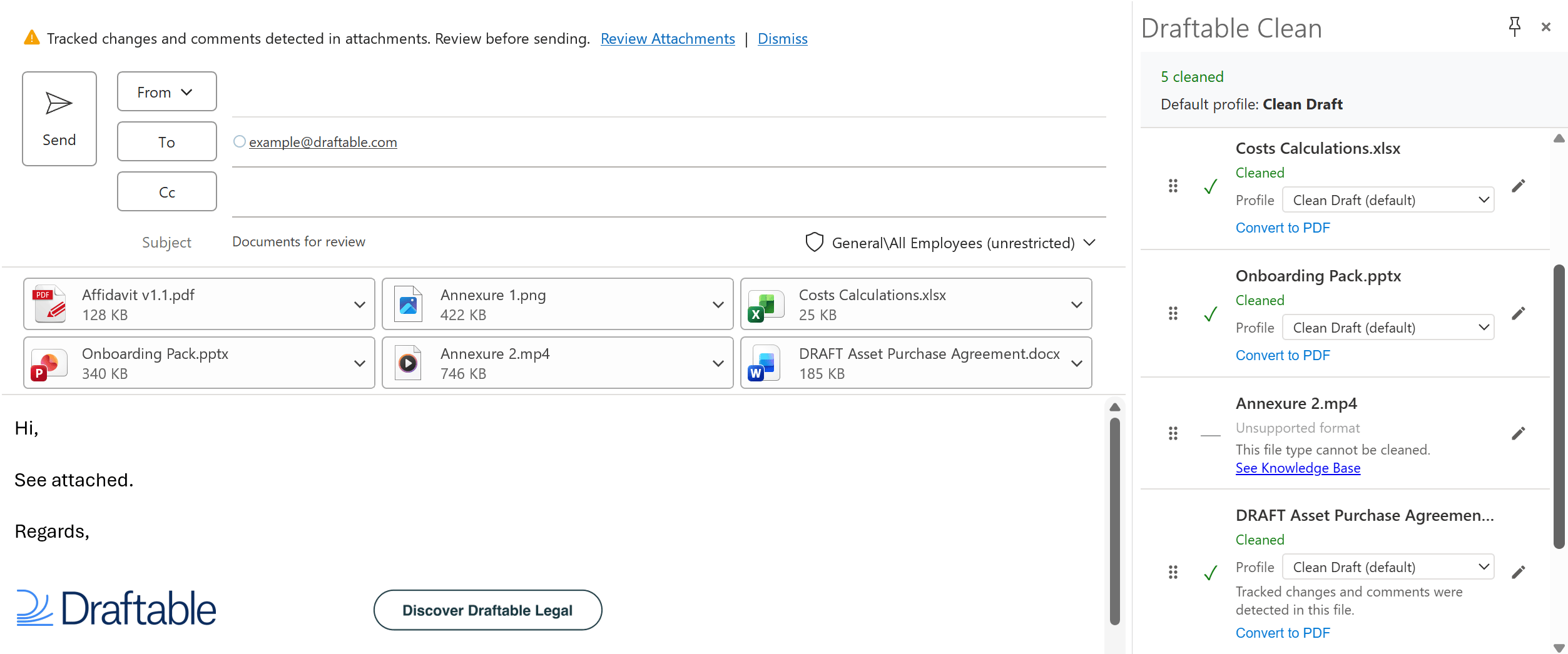
Inserting an attachment list or table
Click Insert Attachment List to add a formatted summary into the email body. The button includes a dropdown arrow with two format options:- List — A bullet-point list of attachment names
- Table — A table with Attachment and Description columns
Send protection
Draftable Clean controls what happens when issues are detected on send. By default:The screenshots below are from New Outlook. Dialogs and prompts appear similarly in Classic Outlook.
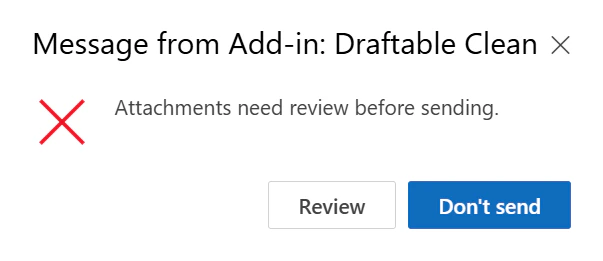
- Attachments not finished cleaning — Sending is blocked with a dialog: “Attachments need review before sending.” The user can click Review to return to the email or Don’t send to cancel.
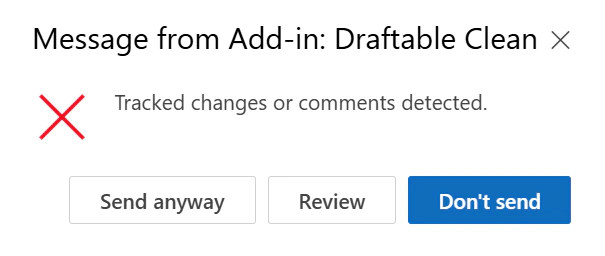
- Tracked changes or comments detected — The user is prompted with a dialog: “Tracked changes or comments detected.” The user can click Send anyway, Review, or Don’t send.
- Unsupported attachment types — Sending is allowed
Next steps
Single-user Installation
Install Draftable Clean on your Windows PC and activate your license or start a free trial.
What is Draftable Clean?
Learn more about Draftable Clean’s features and how metadata cleaning protects your documents.
Supported file types
See which file types Draftable Clean can scan and clean, and what metadata is detected.
Metadata cleaning profiles
Customize how metadata is removed with configurable cleaning profiles.
Supported metadata types
Full reference of every metadata type Draftable Clean can detect and clean.